 ThynkRise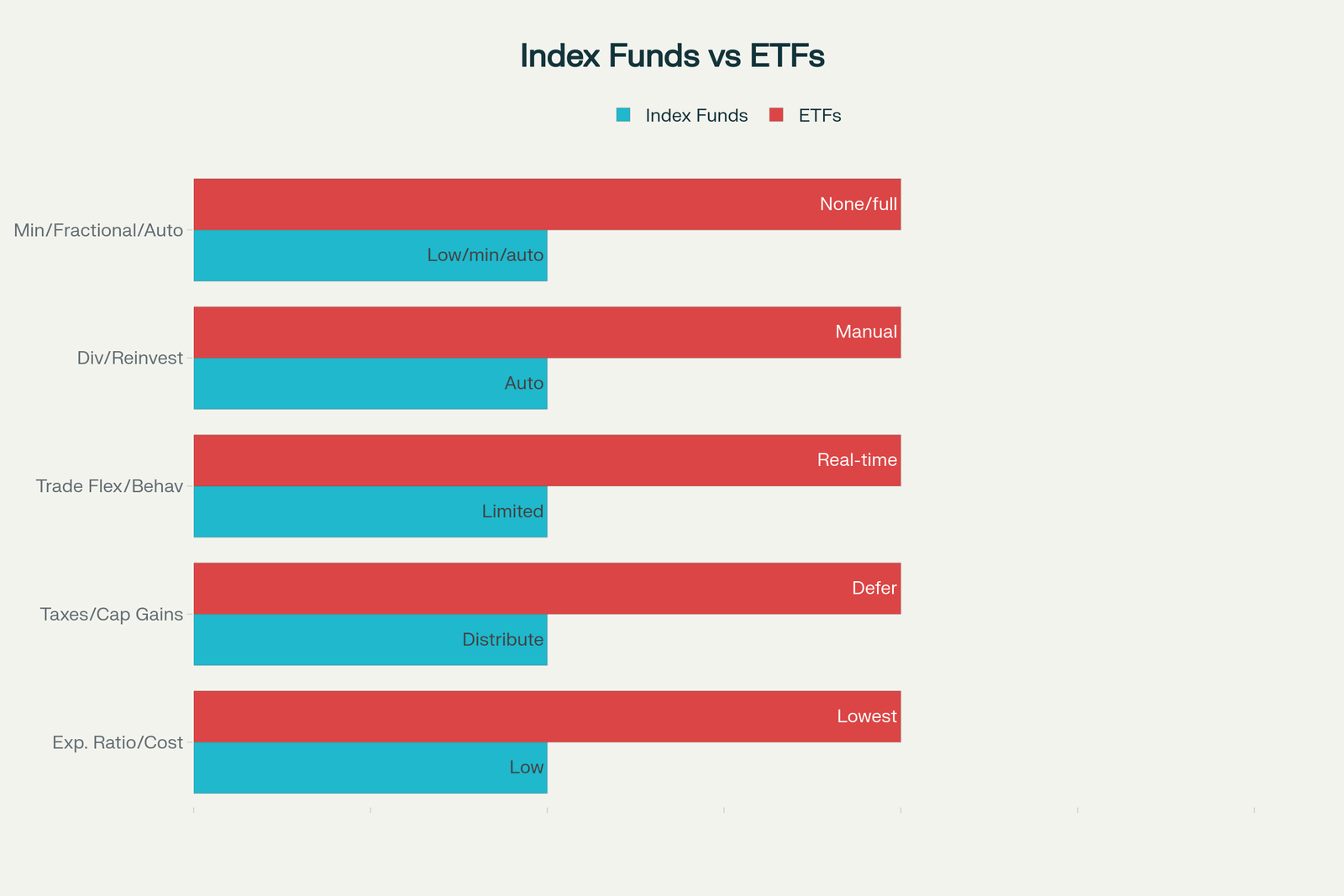
If you’ve searched “index funds vs ETFs” hoping for a clear answer, here’s the honest one: the two overlap far more than they differ. Both track a market index, both charge low fees compared to actively managed funds, and both let you own hundreds of companies in a single purchase. But the differences between them show up in your tax bill, your trading costs, and how fast your money actually compounds — and most investors never look past the “they’re basically the same” headline to find out where.
Here are the five differences that matter once real money is on the line, plus which one fits your situation better.
What They Have in Common First
Before splitting hairs, it’s worth being clear on the overlap. An index fund and an ETF tracking the S&P 500 will hold roughly the same 500 companies, in roughly the same weightings. Historically, their long-term returns track each other closely enough that the difference in performance is usually smaller than the difference in fees. So this isn’t a “which one makes more money” question. It’s a “which one fits how you actually invest” question.
1. Expense Ratios and Trading Costs
Both fund types charge an expense ratio — a small annual fee taken out of your returns automatically. A given fund family’s flagship S&P 500 index fund and its S&P 500 ETF often charge nearly identical rates. The trading cost is where they diverge. Buy an index mutual fund directly from the fund company, and you typically pay no commission. Buy an ETF through a brokerage, and depending on the platform, you might pay a spread between the buy and sell price, even if the trade itself is commission-free. On a single trade, that spread is often just a few cents. Over dozens of trades a year, it adds up.
2. Tax Efficiency: Why ETFs Usually Win in a Taxable Account
This is the difference that costs people the most money without them noticing. Index mutual funds have to sell holdings to meet investor redemptions, and those sales can trigger capital gains that get distributed to every shareholder, including the ones who did nothing but hold. ETFs use a structure called “in-kind creation and redemption” that avoids most of these taxable events. In a retirement account like a 401(k) or IRA, this difference doesn’t matter, since the account is already tax-advantaged. In a regular taxable brokerage account, it can mean the difference between a tax bill you didn’t expect and one you never see.
3. Trading Flexibility and Pricing
Index mutual funds price once a day, after the market closes. You place your order during the day, and it executes at that day’s closing price, whatever it turns out to be. ETFs trade like stocks: their price moves throughout the day, and you can buy or sell at any point the market is open. If you want to react to a specific price or place a limit order, only the ETF structure allows it. If you’re investing on autopilot and don’t check prices intraday, this difference won’t affect you at all.
4. Minimums and Automatic Investing
Many index mutual funds require a minimum initial investment — often $1,000 to $3,000, though some brokerages have dropped this to zero. ETFs trade in whole shares (or fractional shares on platforms that support it), so you can start with whatever a single share costs. Index funds also make automatic, recurring investments simple: set a dollar amount, and the fund company buys fractional shares automatically. ETFs support this too on more platforms than they used to, but it’s not universal — check before assuming your broker offers automatic ETF investing.
5. Dividend Handling and Reinvestment
Index funds usually reinvest dividends automatically and immediately, often the same day they’re paid. ETF dividends typically land in your account as cash first, and reinvestment depends on whether your broker offers a dividend reinvestment program (DRIP) and whether you’ve turned it on. This is a small thing, but a dividend sitting in cash for a few days instead of being reinvested is time out of the market — and over decades, that gap compounds too.
A Real-World Example
Say you invest $10,000 in a taxable account and split it evenly between an S&P 500 index fund and an S&P 500 ETF, then leave both alone for ten years. If the underlying index returns an average of 8% annually, both positions would grow to roughly the same amount before fees and taxes. The expense ratio, if it’s the same on both, chips away an almost identical amount. But if the index fund distributes even $200 in taxable capital gains over that decade — common in years when the fund manager rebalances the portfolio — you’d owe tax on that $200 whether or not you sold anything. The ETF, structured to minimize those distributions, would likely hand you a smaller tax bill for the same underlying performance.
Which One Should You Actually Use?
For a retirement account with automatic contributions, index mutual funds are simpler: set it, forget it, and everything reinvests without you touching anything. For a taxable brokerage account, ETFs generally come out ahead because of the tax treatment, especially once your balance grows large enough for that difference to matter. Plenty of investors use both — index funds inside the 401(k) their employer offers, ETFs inside a personal brokerage account they control directly. The index funds vs ETFs decision usually isn’t either/or.
If you’re just getting started, our guide to five money moves worth making in your 20s covers how to prioritize investing alongside credit, budgeting, and emergency savings, and our Wealth & Investing hub has more on building a full portfolio around funds like these.
Recommended Platform
Want to master this topic? Check out
Zerodha.
It’s a solid platform tailored for exactly this need.
We may earn a commission, at no extra cost to you — it never affects what gets recommended.
Conclusion
Index funds vs ETFs isn’t really a which-is-better contest — both give you low-cost, diversified market exposure, and the differences are in mechanics, not in the underlying investment. Tax treatment and trading flexibility favor ETFs; simplicity and automatic reinvestment favor index funds. Match the tool to the account it’s going in, and the debate mostly resolves itself.
Are ETFs riskier than index funds?
No. Risk comes from what the fund holds, not from its structure. An S&P 500 index fund and an S&P 500 ETF carry the same underlying market risk.
Can I lose money in an index fund or ETF?
Yes. Both track the market, so if the index they follow drops, your investment drops with it. Neither is a guaranteed return.
Do I have to choose only one?
No. Many investors hold index funds in retirement accounts and ETFs in taxable brokerage accounts, using each where its strengths matter most.
Related guides
This article is part of a series. Start with the How to Start Investing in India hub, or continue with: